
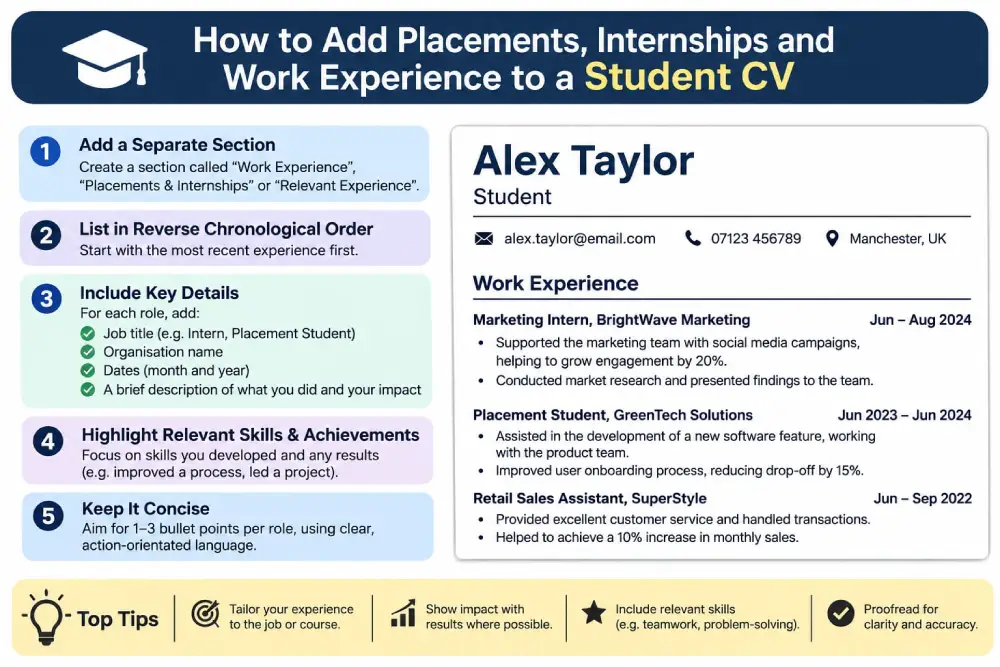
How to Add Placements, Internships and Work Experience to a CV
For students and recent graduates, work experience is often the difference between a CV that gets ignored and one that gets an interview. Placements, internships, part-time jobs, and volunteering all show employers that you can handle responsibility, work with others, and apply what you’ve learned. The challenge is knowing how to present them so they carry real weight.
This guide shows how to list each type of experience, what to include, and how to get the most from limited history.
Why Experience Matters on a Student CV
Employers hiring students and graduates know you won’t have years of experience. What they want to see is evidence of potential: initiative, reliability, and the ability to learn. A placement or internship demonstrates that you can operate in a professional environment. A part-time job shows that you can manage time and work with the public. Volunteering shows motivation and values.
When the experience is well presented, it tells a story of growth. When it’s poorly presented, even a strong placement can read like a list of tasks.
Where to Place It on Your CV
If your experience is relevant to the job, put it above education. If you have little experience or you’re still studying, keep education first and add a clear “Experience” section straight after. Within the section, use reverse chronological order, with the most recent role at the top. If your most relevant role is older, you can create a separate heading such as “Relevant Experience” and list other jobs under “Additional Experience.”
The Formula for Each Role
For every placement or internship, include:
- Job title and organisation
- Location (town or city is enough)
- Dates, by month and year
- Three to five bullet points describing what you did and what resulted
Use this simple pattern for bullets: action verb, task, result. For example:
- “Analysed customer survey data for 300 respondents and produced a summary that shaped the team’s quarterly campaign.”
- “Supported a team of six on a product launch, coordinating schedules and updating the project tracker daily.”
Writing About Different Types of Experience
Placements and sandwich years. Treat them as full roles. Describe projects, tools, and outcomes, and name the department or team. If you rotated through teams, list each briefly.
Internships and summer work. Highlight what you learned and delivered, even in short periods. A six-week internship with a specific project can be more valuable than a vague year-long role.
Part-time jobs. Retail, hospitality, and care roles show customer service, pressure handling, and teamwork. Add numbers, such as customers served per shift or the size of the team.
Volunteering. Charity work, student societies, and community projects count. Describe your responsibility and impact.
Freelance and personal projects. Websites, social media management, tutoring, or content creation demonstrate initiative. Include links to portfolios where relevant.
Shadowing and short placements. Even one or two weeks of observation can be listed with a brief note on what you learned.
Making Limited Experience Look Stronger
If you have little formal experience, don’t pad the CV. Instead:
- Use specific details and numbers
- Link tasks to skills employers want, such as communication, analysis, or leadership
- Add academic projects, group work, and competitions
- Include relevant modules and technical skills
- Show progression, such as “promoted to shift lead after four months”
Tailoring to Each Application
Read the job description and note the skills mentioned. Reorder your bullets so the most relevant come first, and use similar language where it honestly applies. If the advert asks for teamwork and data analysis, make sure those words appear next to real examples. A tailored CV usually performs better than a generic one, and it only takes a few minutes per application.
Beating the Software Filters
Many larger employers use applicant tracking systems that scan CVs before a person sees them. Stick to a simple, single-column layout, clear headings, and a readable font. Avoid text boxes, tables, graphics, and unusual symbols. Use standard titles like “Work Experience” and “Education” so the software can place each section correctly.
When to Get Professional Support
Writing about yourself is hard, and students often underestimate their achievements. If you’re short on time or lack confidence, a best resume writing agency can interview you about your experience, identify the strongest points, and present them clearly. That can be especially helpful when you’re applying for competitive graduate schemes.
When comparing options, it helps to understand what each type of provider offers. A traditional CV Writing Service will usually write the document for you after a consultation. A CV making service with resume experts may combine templates with personal guidance, so you can shape the document yourself with feedback along the way.
Location can matter too. A CV Writing Company in Ireland will be familiar with Irish employers, from multinationals in Dublin to regional firms, and will know how to describe placements such as those run through university work-experience programmes. Look for a team of Expert CV Writers who ask detailed questions about your experience, show real samples, and explain what they change and why.
Your Online Profile Should Match
Employers often search for candidates online. Add your placements, internships, and projects to your profile, with the same dates and job titles as your CV. Use a headline that reflects your target role, and a short summary that highlights your strengths. If you’re based in the capital, you might look for a linkedin profile writer in dublin who understands the local graduate market and can help you appear in recruiter searches. Keeping your CV and profile consistent builds trust.
Common Mistakes to Avoid
- Writing “responsible for” instead of showing what you achieved
- Leaving out dates or using vague time frames
- Listing too many unrelated jobs without focus
- Using the same bullet points for every role
- Including references to confidential information from employers
- Forgetting to proofread job titles and organisation names
A Quick Example
Marketing Intern, Greenfield Media, Dublin
June 2026 to August 2026
- Drafted 24 social media posts that increased average weekly engagement by 18 percent.
- Compiled a competitor analysis used in a client pitch that was later won.
- Scheduled and tracked content across three platforms using a content calendar.
Final Thoughts
Placements, internships, and work experience are some of the most powerful items on a student CV, but only if they’re presented with care. Lead with relevance, describe results, use clear language, and keep the layout simple. Tailor each application, keep your online profile consistent, and ask for feedback from careers advisers, mentors, or professional writers. With the right presentation, even a short placement can open the door to your next role.